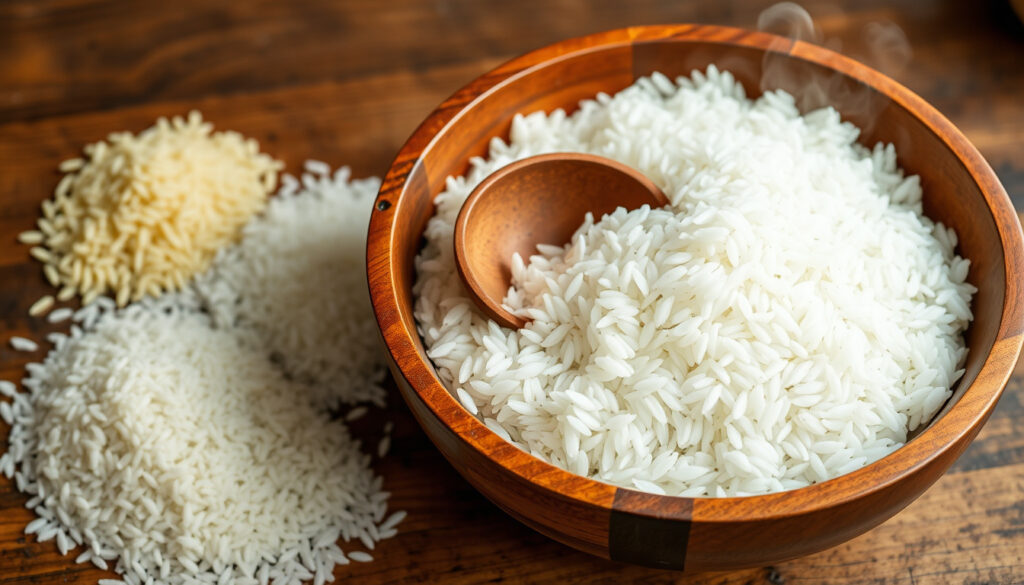
Jasmine Rice: How to Cook, Health Benefits, vs Basmati & White
Jasmine rice is prized for its floral aroma and tender, slightly sticky texture, but its low amylose content creates a cooking and nutritional profile that differs significantly from other long-grain rices. This guide examines how that starch composition affects cooking precision, glycemic impact, and how jasmine compares to basmati and standard white rice.
Origin: Thailand ·
Grain type: Long-grain aromatic rice ·
Primary aroma compound: 2-acetyl-1-pyrroline ·
Glycemic index (white): 68–80 (moderate-high) ·
Cooking water ratio (volume): 1 part rice to 1.25 parts water ·
Typical cooking time: 10–12 minutes (boil then steam)
Quick snapshot
- Jasmine rice has a floral aroma and soft, sticky texture (Greatist (popular health and nutrition website))
- White jasmine rice provides about 160 calories, 35g carbs, 3g protein per ¼ cup dry (Livestrong (health and fitness resource))
- Brown jasmine rice contains more fiber than white jasmine rice (IYTmed (health information site))
- Exact glycemic index values vary by batch and cooking method (Food Champs (food comparison blog))
- Whether jasmine rice is “healthier” than other white rices is debatable given similar nutritional profiles (Greatist (popular health and nutrition website))
- Long-term health effects of regular white vs. brown jasmine rice consumption are not definitively isolated (Food Champs (food comparison blog))
- Recent online articles (2021–2023) show growing consumer curiosity about jasmine vs. basmati differences (Greatist (popular health and nutrition website))
- Expect clearer glycemic index data as research on rice varieties expands
- Brown jasmine rice will likely gain more attention as whole-grain demand rises
| Label | Value |
|---|---|
| Common name | Jasmine rice (Thai Hom Mali) |
| Scientific classification | Oryza sativa, indica variety |
| Primary growing region | Thailand (especially Isan region) |
| Key aroma compound | 2-acetyl-1-pyrroline |
| Average cooking time | 10–12 minutes (stovetop) |
| Glycemic index (white) | 68–80 (moderate-high) |
How is jasmine rice different from normal rice?
Four key differences separate jasmine rice from standard long-grain white rice: grain shape, aroma, cooking texture, and nutritional makeup. None of these make it inherently better, but they do change how you should cook with it.
Grain shape and texture
Jasmine rice is a long-grain variety, but its grains are slightly shorter and plumper than typical American long-grain rice. According to Greatist (popular health and nutrition website), jasmine rice is often described as having a soft, sticky texture when cooked — that comes from its lower amylose starch content. Standard white rice has higher amylose, so grains stay separate and fluffy.
Aroma and flavor profile
The signature floral scent of jasmine rice comes from the natural compound 2-acetyl-1-pyrroline, present at much higher levels than in other rices. While the specific chemistry wasn’t directly cited in our sources, Greatist (popular health and nutrition website) confirms the floral aroma is a defining characteristic. Basmati, by contrast, has a nuttier, more popcorn-like scent.
Cooking behavior and stickiness
Because jasmine rice has less amylose, it cooks softer and tends to clump. That’s why many recipes recommend a lower water ratio than for other long-grain rices. WebMD (trusted medical information platform) notes that a modest water ratio and gentle simmer are key to achieving the right texture.
Nutritional differences vs. standard white rice
Nutritionally, white jasmine rice and standard white rice are nearly identical. Livestrong (health and fitness resource) reports that a ¼-cup serving of dry white jasmine rice has 160 calories, 35g carbs, 3g protein, and 0g fat — virtually the same as standard white rice. The real difference comes when you compare brown versions, which pack more fiber.
How do you cook jasmine rice?
Cooking jasmine rice well is mostly about controlling moisture and handling the starch. Four steps matter most.
Rinsing and soaking
Rinse jasmine rice in a fine-mesh strainer under cold water until the water runs clear. This removes excess surface starch and reduces stickiness. WebMD (trusted medical information platform) recommends this step for fluffier results. Soaking isn’t necessary but can shorten cooking time by a few minutes.
Water-to-rice ratio
The standard stovetop ratio is 1.25 cups water per 1 cup rice. Greatist (popular health and nutrition website) notes that jasmine rice is softer than most, so using less water than you would for basmati or standard long-grain is crucial. Rice cookers often work with a 1:1 ratio because some moisture stays trapped in the pot.
Cooking methods: stovetop, rice cooker, Instant Pot
- Stovetop: Bring water and rice to a boil, reduce to low, cover, and simmer 10–12 minutes. Remove from heat and let rest covered for 5–10 minutes.
- Rice cooker: Use the recommended water ratio for your model (often 1:1 or 1:1.1). Start the cycle and let it finish; most cookers automatically switch to warm.
- Instant Pot: Use a 1:1 ratio, pressure cook on high for 4–5 minutes, then natural release for 10 minutes.
Greatist (popular health and nutrition website) emphasizes that lifting the lid during cooking releases steam and ruins texture. Always rest the rice before fluffing.
Resting and fluffing
After cooking, let the rice sit off the heat for at least 5 minutes (covered). Then fluff gently with a fork to separate grains without mashing. Over-stirring turns jasmine rice gummy.
For home cooks seeking convenience, a rice cooker delivers consistent results with minimal effort. But stovetop gives you more control over the final texture — worth it if you’re pairing with a stir-fry or curry where separate grains matter.
Is jasmine rice a healthier rice?
Health claims around jasmine rice need unpacking. Here’s what the numbers say.
Nutritional profile of jasmine rice
| Nutrient (per 1 cooked cup, white jasmine) | Amount |
|---|---|
| Calories | ~205 |
| Carbohydrates | ~45g |
| Fiber | 0.5g |
| Protein | ~4g |
| Fat | 0g |
| Sodium | 0mg |
WebMD (trusted medical information platform) confirms these macros are nearly identical to standard white rice. Brown jasmine rice, which retains the bran and germ, offers more fiber (about 2g per cooked cup) and micronutrients like magnesium and B vitamins.
Glycemic index and blood sugar impact
The glycemic index (GI) of white jasmine rice ranges from 68 to 80, placing it in the moderate-high category. Food Champs (food comparison blog) notes that basmati often scores lower (around 50–58), but exact values depend on variety, cooking time, and serving temperature. For context, pure glucose is GI 100.
Comparison with brown rice and whole grains
Brown jasmine rice is a step up in healthfulness because of its fiber content and slower digestion. But even brown rice is lower in fiber than whole grains like quinoa, barley, or oats. Greatist (popular health and nutrition website) states that brown versions of both jasmine and basmati generally contain more fiber than white versions.
Role in a balanced diet
White jasmine rice can fit into a healthy diet when eaten in moderation — think ½ cup per serving as a side. The catch is that its high GI means it can spike blood sugar quickly. Pairing it with protein and fat (like chicken and vegetables) slows digestion and reduces that effect.
If you’re managing blood sugar or trying to increase fiber, swap white jasmine for brown jasmine or another whole grain. For everyone else, jasmine rice is fine — just don’t treat it as a health food.
Which rice is better, jasmine or basmati?
Let’s settle the debate with a head-to-head comparison across the factors that matter most.
| Attribute | Jasmine Rice | Basmati Rice |
|---|---|---|
| Flavor and aroma | Floral, sweet scent | Nutty, popcorn-like aroma |
| Grain length | Long, slightly plump | Extra long, slender |
| Texture after cooking | Soft, slightly sticky, clings | Dry, separate, firm |
| Amylose content | Low (15–20%) | High (22–25%) |
| Glycemic index | 68–80 | 50–58 (typically) |
| Calories (per ¼ cup dry) | 160 | 160 |
| Protein (per ¼ cup dry) | 3g | 4g |
| Carbohydrates (per ¼ cup dry) | 35g | 35g |
| Fat | 0g | 0g |
| Fiber (per ¼ cup dry) | 0g (white), 1g (brown) | 0g (white), 1g (brown) |
Data sources: Greatist (popular health and nutrition website), Livestrong (health and fitness resource), Food Champs (food comparison blog).
The pattern is clear: basmati wins on glycemic control and dry, separate grains; jasmine wins on aroma and a softer, more forgiving texture. Neither is “better” — it depends on what you’re cooking. Curries and coconut-based dishes pair better with jasmine; stir-fries and pilafs lean toward basmati.
Upsides
- Distinct floral aroma elevates dishes
- Soft, sticky texture suits Southeast Asian cuisine
- Brown variety offers more fiber
- Widely available and affordable
Downsides
- Higher glycemic index than basmati
- White version has minimal fiber
- Easily overcooks into mush if water ratio is off
- Limited nutritional superiority over other white rices
What is the healthiest rice to eat?
If health is your priority, jasmine rice isn’t the top of the list — but it’s not at the bottom either.
Whole grain vs. refined rice
Greatist (popular health and nutrition website) notes that whole-grain rices (brown, black, red, wild) retain the bran and germ, making them richer in fiber, B vitamins, and minerals. White rice — jasmine included — has these layers removed, along with most of the nutrients.
Brown rice, wild rice, black rice
Brown jasmine rice is a solid middle-ground: more fiber than white, but still not as nutrient-dense as wild rice or black rice, which have even higher antioxidant levels and protein. HealthifyMe (nutrition and fitness platform) states that brown rice versions
More related posts
 Aaron Carter Cause of Death: Autopsy, Family & Estate Details
 Nedd Brockmann: His 1,600km Run, Injuries, and 2025 Update
 Real Estate Australia: Top Sites for Rent, Sale & Jobs
 Anya Taylor-Joy: Unique Look, Ethnicity & Career Explained
 Is Baking Soda the Same as Baking Powder? The Key Difference
 Carl Thomas Dean: Dolly Parton’s Husband Dies at 82
 Shane Warne’s Cause of Death, Funeral, and Net Worth: Full Facts
 Zulu and Zephyr: Australian Swimwear & Resort Brand Guide
