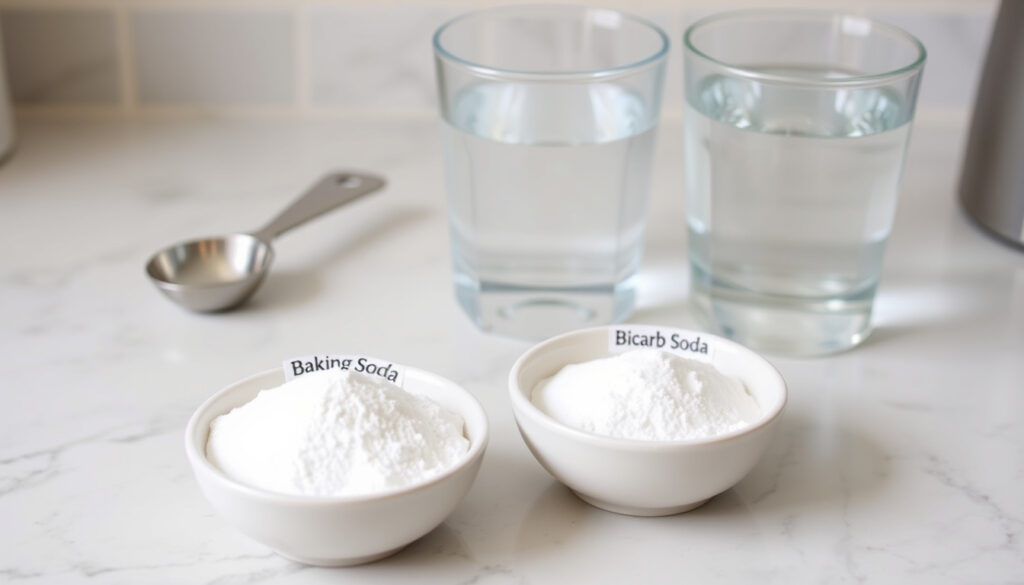
Is Bicarb Soda the Same as Baking Soda? Key Differences Explained
Despite the different names on the boxes—”baking soda” in the US and “bicarbonate of soda” in the UK—the white powder inside is chemically identical. Let’s clear up exactly what this white powder is, how its name changes depending on where you shop, and when you should reach for it in the kitchen, the bathroom, or the laundry room.
Chemical formula: NaHCO₃ (sodium bicarbonate) ·
Common names: baking soda, bicarb soda, bicarbonate of soda ·
Regional terminology: US uses “baking soda”; UK/AU use “bicarb soda” ·
Product identity: Identical chemical compound, different regional terms only
Quick snapshot
- Both are sodium bicarbonate (NaHCO₃) (Ishtar Company (chemical manufacturer reference))
- Pure, identical powder (Ishtar Company (chemical manufacturer reference))
- Difference is only regional naming (World of Spice (specialty culinary retailer))
- Leavening agent in baking (World of Spice (specialty culinary retailer))
- Needs acid to activate (e.g., lemon juice, buttermilk) (World of Spice (specialty culinary retailer))
- 1 tsp bicarb = 1 tsp baking soda (World of Spice (specialty culinary retailer))
- May reduce inflammation (limited evidence) (Verywell Health (health information publisher))
- Drinking can raise blood pressure; caution needed (American Heart Association (heart health authority))
- Effective gentle abrasive cleaner (World of Spice (specialty culinary retailer))
- Deodorizer in refrigerators and carpets (World of Spice (specialty culinary retailer))
- Safe for skin when diluted; avoid overuse (World of Spice (specialty culinary retailer))
Five key facts about this common household ingredient, one consistent pattern: every variation points back to the same chemistry.
| Property | Details |
|---|---|
| Chemical formula | NaHCO₃ |
| Other names | Baking soda, bicarbonate of soda, bicarb soda, cooking soda (Ishtar Company (chemical manufacturer reference)) |
| Edibility | Edible in small quantities (common in recipes) |
| Regional usage | US: “baking soda”; UK/AU: “bicarb soda” (World of Spice (specialty culinary retailer)) |
| Activation | Requires acid (vinegar, lemon juice, buttermilk) (World of Spice (specialty culinary retailer)) |
Is baking soda and bicarbonate of soda the same thing?
Yes—chemically, they are identical. Both are sodium bicarbonate (NaHCO₃), a salt compound made of sodium cations and bicarbonate anions. The only real difference is what people call it depending on where they live. In the United States, it is almost always labeled “baking soda.” In the United Kingdom, Australia, and New Zealand, you will find it sold as “bicarbonate of soda” or simply “bicarb soda.” (World of Spice (specialty culinary retailer))
Chemical identity of sodium bicarbonate
- Pure sodium bicarbonate is a white, crystalline powder.
- The formula NaHCO₃ is the same whether the box says “baking soda” or “bicarbonate of soda.” (Ishtar Company (chemical manufacturer reference))
- No additives, fillers, or differences in purity exist between the two named products at standard grocery retail.
A shopper in London and a shopper in Los Angeles are reaching for the exact same chemical—the only difference is the label language. For anyone following a recipe from another country, the substitution is direct and safe.
Regional naming differences: US vs UK/Australia
- US grocers stock “baking soda” in the baking aisle.
- UK grocers stock “bicarbonate of soda” (sometimes shortened to “bicarb”).
- Australian and New Zealand stores use “bicarbonate of soda” and “bicarb soda” interchangeably.
The pattern: this is purely a nomenclature difference, not a product difference. A British recipe calling for “bicarbonate of soda” and an American recipe calling for “baking soda” are asking for the same ingredient in the same quantity.
Can I use bicarb instead of baking soda?
Yes—and in exactly the same quantity. Since they are the same chemical compound, you can substitute 1 teaspoon of bicarb for 1 teaspoon of baking soda in any recipe without adjusting measurements or altering the outcome. (World of Spice (specialty culinary retailer))
Substitution in cooking recipes
- Mix 1:1 by volume—no math required.
- No change in leavening power, taste, or texture.
- The same activation rules apply: the powder needs an acidic ingredient (like lemon juice, vinegar, buttermilk, or yogurt) to release carbon dioxide and create rise.
Home bakers who follow international recipes often panic when they see a different name. The consequence of knowing they are identical is simple: no guesswork, no failed cakes, no wasted ingredients. Anyone who cooks across cuisines can treat the names as regional synonyms.
Potential differences in texture or taste
- None arise from the ingredient itself—the chemical is identical.
- Texture or taste issues in a recipe usually trace to incorrect measurement, missing acid, or old stock that has absorbed moisture and lost potency.
The catch: if a recipe calls specifically for “baking powder,” do not substitute bicarb or baking soda without adjusting the acid balance. Baking powder contains its own acid (typically cream of tartar) and requires a different substitution ratio—roughly 3 parts baking powder for 1 part baking soda.
How to use baking soda for inflammation relief and kidney health?
Some people drink small amounts of baking soda dissolved in water for potential health benefits, but the evidence is limited and carries risks. Here is what is known and what remains uncertain.
Baking soda and inflammation reduction
- Some research suggests sodium bicarbonate may reduce inflammation by altering the body’s pH balance.
- Verywell Health (health information publisher) has noted that while the mechanism is plausible, the evidence from human trials is reportedly not strong enough to recommend routine use.
Effect of bicarbonate supplementation on kidney function
- Bicarbonate supplementation has been studied in patients with chronic kidney disease (CKD) because the kidneys naturally produce bicarbonate.
- Limited studies suggest it may help slow CKD progression in some patients.
- However, the effect on creatinine levels is reportedly not universally confirmed across larger trials.
A person with healthy kidneys does not need bicarbonate supplements. For someone with kidney disease, self-medicating with baking soda can worsen electrolyte imbalances. The safest route is a doctor’s guidance before any daily intake.
Risks of drinking baking soda (including for high blood pressure)
- Sodium bicarbonate is high in sodium—about 1,200 mg per teaspoon.
- Regular daily consumption can raise blood pressure, especially in people with hypertension.
- Drinking baking soda can also cause electrolyte imbalances, metabolic alkalosis, and stomach rupture if taken in large amounts.
- The rumor that a teaspoon a day is beneficial for everyone is not supported by strong scientific evidence for the general population.
The pattern: any potential benefit for inflammation or kidney function is dose-specific and context-dependent, and the risks for a person with high blood pressure or kidney disease are concrete and well-documented. Self-directed daily use is not advisable without medical supervision.
Is bicarb soda the same as baking soda for cleaning and skin?
Yes—and the identical chemistry means they work the same way for both cleaning and skincare. Since it is the same white powder regardless of the name on the box, any cleaning or topical application that works with baking soda works exactly as well with bicarb soda.
Best uses for cleaning
- Gentle abrasive cleaner for sinks, tubs, and countertops.
- Deodorizer for refrigerators, carpets, and shoes.
- Can combine with vinegar to create a foaming cleaning reaction for drains or ovens.
Skin applications and safety
- Baking soda paste (mixed with a little water) is used as a gentle exfoliant and to soothe minor skin irritations.
- Safe for occasional topical use when diluted.
- Avoid overuse—alkaline baking soda can disrupt the skin’s natural pH barrier if applied too frequently.
The implication: a UK resident who bought “bicarbonate of soda” for kitchen cleaning can use it for a face mask or a foot soak using the same measurements as a US resident with “baking soda.” The only variable is the label.
Is a teaspoon of baking soda a day good for you?
This is one of the most searched questions about bicarb soda, and the answer depends heavily on who you are. For some people, a small daily dose might offer marginal benefits; for others, it is a genuine health risk.
Potential benefits of daily consumption
- May temporarily reduce stomach acidity for heartburn relief.
- Some athletes use small doses to buffer lactic acid during intense exercise—though reportedly with mixed results in controlled studies.
- In people with diagnosed metabolic acidosis, bicarbonate supplementation can be medically prescribed.
Risks and side effects
- High sodium intake from daily baking soda can elevate blood pressure and increase cardiovascular strain.
- Long-term daily use can cause hypokalemia (low potassium) and metabolic alkalosis.
- The American Heart Association (heart health authority) recommends limiting sodium to 2,300 mg per day—one teaspoon of baking soda already provides over half that limit.
The catch: a person with normal blood pressure and healthy kidneys is reportedly unlikely to be harmed by the occasional teaspoonful, but the case for routine daily consumption in healthy people is weak. For a person with hypertension, the same dose carries a real, measurable risk. Bicarb soda is the same as baking soda, and you can find out more about Devon Rex till salu pris uppfödare.
Confirmed facts vs. What remains unclear
Confirmed facts
- Baking soda and bicarb soda are chemically identical (NaHCO₃) (Ishtar Company (chemical manufacturer reference))
- US term “baking soda” vs. UK/AU term “bicarb soda” are regional names for the same product (World of Spice (specialty culinary retailer))
- Baking powder is not the same—it contains its own acid (My Wellbeing Journal (home baking resource))
What’s unclear
- Exact effectiveness of baking soda for reducing inflammation in the general population
- Long-term safety of daily teaspoon consumption for healthy adults
- Effect on kidney creatinine levels is not universally confirmed in large-scale trials
- Both are sold as pure sodium bicarbonate (purity not explicitly confirmed by all sources)
- Baking soda requires an acid to activate (common knowledge but some confusion exists)
Comparison: Baking Soda vs Bicarbonate of Soda vs Baking Powder
| Property | Baking Soda (US) | Bicarbonate of Soda (UK/AU) | Baking Powder |
|---|---|---|---|
| Chemical formula | NaHCO₃ | NaHCO₃ | NaHCO₃ + acid (e.g., cream of tartar) |
| Needs acid to activate? | Yes | Yes | No (acid already included) |
| Common uses | Leavening, cleaning, deodorizing | Same as baking soda | Leavening only |
| Substitution ratio | 1 tsp = 1 tsp bicarb | 1 tsp = 1 tsp baking soda | 3 tsp for 1 tsp baking soda |
“Bicarbonate of soda and baking powder are not the same; they are both raising agents but with different compounds.”
— World of Spice (specialty culinary retailer)
“While the mechanism is plausible, the evidence from human trials is not strong enough to recommend routine use for inflammation.”
Reportedly, this reflects the cautious consensus among health researchers.
— Verywell Health (health information publisher)
For readers wondering about regional naming differences, bicarbonate of soda and baking soda are chemically identical substances used in cooking and cleaning.
Frequently asked questions
Is baking soda safe to drink daily?
Not recommended for everyone. Daily use can raise blood pressure and cause electrolyte imbalances. Consult a doctor first.
Does baking soda help with kidney disease?
Some evidence suggests bicarbonate may slow chronic kidney disease progression in specific patients, but it is not a general treatment and should only be used under medical supervision.
What is the difference between baking soda and baking powder?
Baking soda is pure sodium bicarbonate and needs an acid to activate. Baking powder already contains an acid (cream of tartar) and only needs moisture and heat. (My Wellbeing Journal (home baking resource))
Can I use baking soda to clean my teeth?
Yes—it acts as a gentle abrasive. Use occasionally to avoid wearing down enamel.
Is it safe to use baking soda on skin?
Yes, when diluted with water. Avoid overuse as its alkalinity can disrupt the skin’s natural pH barrier.
Does baking soda expire?
It does not spoil, but it can absorb moisture and lose potency over time. Test by adding a little vinegar—if it fizzes vigorously, it is still active.
Related reading
More related posts
 Shayne Topp: Age, Career, Marriage, and Smosh Controversies
 Menendez Brothers: Parole Denied, Prison Status & Key Facts
 Germaine Greer: Biography, The Female Eunuch, and Life
 Tom Morris: Golfer, Philosopher, Journalist & Director
 Kira Pregiato: Verified Facts & Social Media Presence
 DJI Mic Mini – Specs, Comparison and Value Guide
 Paige Turco: Biography, Ethnicity, and Career Journey
 Jermaine Jackson: Jackson 5, Solo Career & Family Drama
