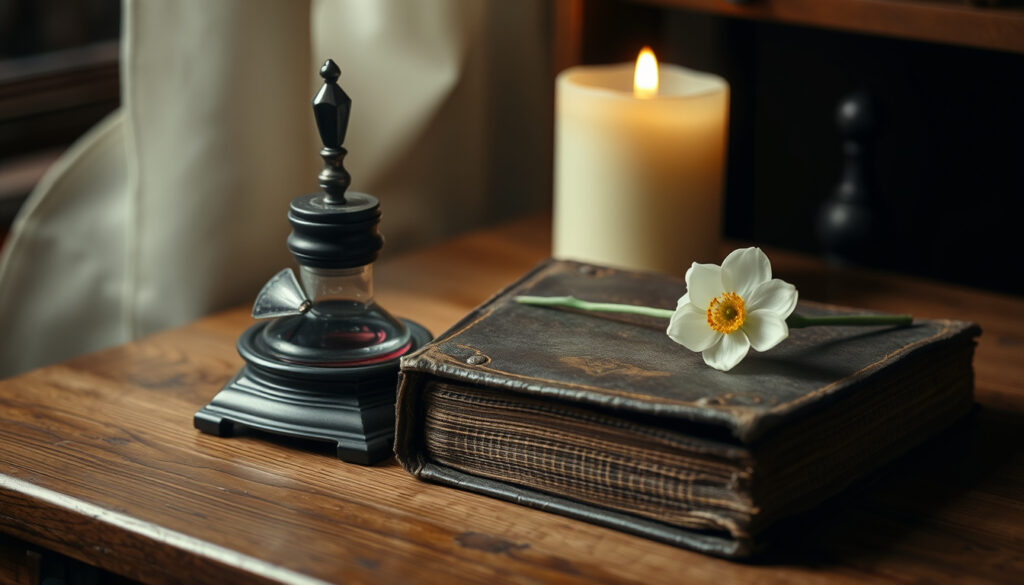
Emily Dickinson: Life, Poems, Illness, and Love Life Explained
Emily Dickinson’s name conjures an image as vivid as her poetry—a woman in white, secluded in Amherst, writing thousands of poems the world would discover only after her death. This article separates confirmed facts from speculation about her health, love life, and literary legacy.
Born: December 10, 1830 · Died: May 15, 1886 · Poems written: nearly 1,800 · Poems published in her lifetime: fewer than a dozen · First posthumous collection: 1890
Quick snapshot
- Born in Amherst, Massachusetts, on December 10, 1830 (Emily Dickinson Museum (biographical archive))
- Died on May 15, 1886, at age 55 (Encyclopaedia Britannica (reference work))
- Wrote nearly 1,800 poems (Poetry Foundation (literary archive))
- Exact nature of her physical and mental illnesses (Emily Dickinson Museum (health research))
- Identity of her romantic interests and whether she ever had a physical relationship (Poetry Foundation (biographical note))
- Whether her seclusion was a choice or a symptom of a condition (Psychology Today (analysis))
- Who the “Master” of her letters was (Emily Dickinson Museum (biographical archive))
- 1830 – Born in Amherst
- 1862 – Writes to critic Thomas Wentworth Higginson
- 1886 – Dies of nephritis
- 1890 – First posthumous collection published
- Continued scholarly interest in her health records and letters
- New editions of her complete works with modern editorial approaches
- Ongoing debate about her romantic life and the “Master Letters”
Six key facts, one pattern: each datum reveals a life shaped by privacy and a legacy built after death.
| Label | Value |
|---|---|
| Full Name | Emily Elizabeth Dickinson |
| Birth | December 10, 1830, Amherst, Massachusetts |
| Death | May 15, 1886, Amherst, Massachusetts |
| Occupation | Poet |
| Notable Work | Poems by Emily Dickinson (1890) |
| Literary Period | 19th-century American Romanticism |
What is Emily Dickinson most famous for?
Her unique poetic style
Dickinson is most famous as one of America’s greatest poets, with a style that challenged every convention of her time. Her poems are short, packed with slant rhyme, irregular dashes, and a compression of meaning that forces readers to slow down. According to the Poetry Foundation (literary authority), her work is “highly original” and “challenged conventional definitions of poetry.”
A poet who wrote nearly 1,800 poems but only saw about a dozen published in her lifetime. Her fame came entirely after death, shaped by editors who reworked her raw verses.
Her life as a recluse
By her mid-20s, Dickinson began withdrawing from society. She eventually stopped leaving her family home in Amherst, Massachusetts, and took to wearing only white clothing. The Emily Dickinson Museum (biographical archive) confirms that she rarely received visitors in her later years.
Her posthumous fame
The first volume of her poetry, edited by Mabel Loomis Todd and Thomas Wentworth Higginson, was published in 1890. It was an immediate success, going through 11 editions in less than two years, according to the Poetry Foundation (literary archive).
The implication: her fame rests on the paradox of a public legacy built from a private life.
What illness did Emily Dickinson suffer from?
Theories on her physical health
Scholars debate the exact illness. The Emily Dickinson Museum (health research) notes that she had consumptive symptoms in 1851 and later eye problems that were likely iritis, diagnosed by Boston ophthalmologist Henry Willard Williams in 1864. She lived in Cambridgeport for treatment from April to December 1864, and again from April to October 1865. Her death in 1886 was attributed to nephritis (Bright’s disease).
Debate over her mental health
Her reclusiveness has led to speculation about agoraphobia or other conditions. According to Psychology Today (popular psychology magazine), her doctors reportedly diagnosed neurasthenia or nervous prostration, though modern interpretations vary. The exact cause of her withdrawal remains unclear.
Her final illness and death
By late 1885, she was frail and mostly bedridden. She died on May 15, 1886, at age 55. The Encyclopaedia Britannica (reference work) lists the cause as nephritis.
What this means: the gaps in her medical history leave room for ongoing scholarly debate.
What famous poem did Emily Dickinson write?
Her most anthologized works
Her most famous poems include “Because I could not stop for Death” and “I’m Nobody! Who are you?”. The Poetry Foundation (literary archive) notes that she wrote nearly 1,800 poems, but only a handful were published in her lifetime.
Themes of nature and death
Her poems often explore death, immortality, nature, and love. She is known for her short lines, slant rhyme, and unconventional punctuation. The Encyclopaedia Britannica (reference work) describes her work as “deeply original” and “ahead of its time.”
The role of her poetry in modern culture
Her poems are now canonized in American literature, studied in schools and referenced in films, music, and popular culture. The Library of Congress holds a 1924 edition of The complete poems of Emily Dickinson (Library of Congress (national library)).
The pattern: her best-known lines were written in obscurity, only later elevated to cultural touchstones.
Did Emily Dickinson have a baby?
Evidence for and against
There is no confirmed historical evidence that Emily Dickinson had a baby. The Emily Dickinson Museum (biographical archive) states that she never married and lived with her family for her entire life. No reliable records indicate a pregnancy or child.
Theories about a secret romance
Some biographers have speculated about a possible hidden pregnancy, but this is not supported by reliable sources. The Poetry Foundation (biographical note) notes that such theories remain unsubstantiated.
Historical records
Dickinson’s letters and family documents contain no mention of a child. Her reclusive lifestyle makes it difficult to confirm or deny rumors, but the consensus among scholars is that she did not give birth.
The catch: absence of evidence is not evidence of absence, but the scholarly consensus is clear.
Did Emily Dickinson ever have a lover?
Known correspondences
She had significant correspondences, including with Judge Otis Lord, a friend of her father. According to the Poetry Foundation (biographical note), these letters suggest a close emotional bond, though the nature of the relationship remains unclear.
The Master Letters
The three “Master Letters” – addressed to an unnamed “Master” – suggest a passionate but unrequited love. The Emily Dickinson Museum (biographical archive) describes them as “intensely personal” and likely never sent. The identity of “Master” is unknown.
Her relationship with Judge Otis Lord
After Lord’s wife died, he and Dickinson may have considered marriage. The Encyclopaedia Britannica (reference work) notes that Lord was a significant figure in her later life, but the relationship never led to marriage.
The implication: her emotional life remains a puzzle, with the letters offering only fragments.
What was Emily Dickinson’s most famous line?
Commonly cited quotes
A widely famous line is “Hope is the thing with feathers” from her poem of the same name. Another is “I dwell in Possibility” from a poem about poetic expression. The Poetry Foundation (literary archive) lists these among her most anthologized lines.
Lines from her most famous poems
“Because I could not stop for Death – He kindly stopped for me” is another iconic opening. Her lines often focus on nature, death, immortality, and inner life, with a distinctive use of dashes and capitalisation.
Quotes about hope and resilience
“Hope is the thing with feathers” has become a cultural touchstone, quoted in speeches, songs, and social media. The line’s enduring popularity reflects Dickinson’s ability to distill complex emotions into simple, memorable images.
The pattern: her most quoted lines are those that compress large ideas into a few words.
Did Emily Dickinson ever marry?
Reasons for her singlehood
Emily Dickinson never married. The Emily Dickinson Museum (biographical archive) confirms that she remained single throughout her life. Her reclusive nature likely played a significant role in her unmarried status.
Relationships and proposals
She had several close friendships and correspondences with men, including Otis Lord and Thomas Wentworth Higginson, but no known marriage proposal was accepted. The Encyclopaedia Britannica (reference work) notes that she may have considered marriage to Lord late in his life, but it never materialised.
Her social circle
Dickinson’s world was primarily her family and a small circle of correspondents. She maintained friendships through letters, many of which have been preserved and studied.
What this means: her choice of solitude over marriage remains a defining feature of her biography.
Timeline
- – Emily Elizabeth Dickinson born in Amherst, Massachusetts (Emily Dickinson Museum)
- – Begins writing poetry seriously; forms key correspondences (Poets.org / Academy of American Poets)
- – Writes to literary critic Thomas Wentworth Higginson, seeking advice (Poetry Foundation)
- – Deepens reclusiveness; continues prolific writing (Encyclopaedia Britannica)
- – Dies of nephritis (Bright’s disease) at age 55 (Encyclopaedia Britannica)
- – First collection of her poems published posthumously (Poetry Foundation)
- – Thomas H. Johnson publishes a complete, unaltered edition of her poems (Library of Congress)
The pattern: each event deepens the paradox of a public legacy built on private life.
Clarity: facts vs. speculation
Confirmed facts
- Emily Dickinson was born in 1830 and died in 1886 (Encyclopaedia Britannica (reference work)).
- She wrote nearly 1,800 poems (Poetry Foundation (literary archive)).
- She never married or had children (Emily Dickinson Museum (biographical archive)).
- Her first poetry collection was published posthumously in 1890 (Poetry Foundation (literary archive)).
What remains unclear
- The exact nature of her illnesses (both physical and mental).
- The identity of her romantic interests and the nature of her correspondences.
- Whether she deliberately chose seclusion or suffered from a condition.
- Who the recipient of the “Master Letters” was.
Scholars continue to debate whether Dickinson’s physical ailments were purely organic or had psychological components, and no single diagnosis has achieved consensus.
Quotes from key figures
“Hope is the thing with feathers / That perches in the soul.”
— Emily Dickinson, from her poem “Hope is the thing with feathers”
“I dwell in Possibility – / A fairer House than Prose –”
— Emily Dickinson, from her poem “I dwell in Possibility”
“[Her poems] are quite unlike anything else in the world, and they must be read as they are.”
— Thomas Wentworth Higginson, editor and critic, in a letter to his wife (quoted in Poetry Foundation)
What this means: Dickinson’s own words and the reactions of her contemporaries reveal a poet who knew her worth, even if the world took decades to catch up.
For readers exploring Emily Dickinson, the choice is clear: read her poems as she wrote them, not as her editors smoothed them. The unaltered texts reveal a sharper, riskier voice than the one that first appeared in 1890. For scholars, the ongoing work of interpreting her letters and health records continues to refine our understanding of a woman who chose to live on her own terms – and whose poetry speaks across centuries.
archive.org, en.wikipedia.org, prod-edxapp.edx-cdn.org, emilydickinsonmuseum.org, library.centre.edu
Frequently asked questions
What is Emily Dickinson’s most famous poem?
“Because I could not stop for Death” and “I’m Nobody! Who are you?” are among her most anthologized works. See Poetry Foundation.
How many poems did Emily Dickinson write?
She wrote nearly 1,800 poems. Only about a dozen were published during her lifetime (Poetry Foundation).
Who discovered Emily Dickinson’s poems?
Her sister Lavinia found the poems after her death and enlisted Mabel Loomis Todd and Thomas Wentworth Higginson to edit and publish them (Emily Dickinson Museum).
Where did Emily Dickinson live?
She lived her entire life in Amherst, Massachusetts, mostly in the family home known as the Dickinson Homestead (Emily Dickinson Museum).
What was Emily Dickinson’s writing style?
Short lines, slant rhyme, unconventional punctuation, and dashes. Her style is often described as compressed and highly original (Encyclopaedia Britannica).
Why did Emily Dickinson wear white?
She adopted white clothing in her later years, possibly as a personal symbol of purity or renunciation. The exact reason is unknown (Emily Dickinson Museum).
What is the main theme of Emily Dickinson’s poetry?
Major themes include death, immortality, nature, love, and the inner life of the mind (Poetry Foundation).
More related posts
 Gerran Howell: Age, Wife, Movies, The Pitt Role (2025)
 Is Bicarb Soda the Same as Baking Soda? Key Differences Explained
 Becky Hill: Singer vs. Court Clerk – Who’s Who
 Rydges Sydney Airport – Reviews, Prices, Parking, Shuttle Guide
 Ada Lovelace: First Computer Programmer’s Life & Legacy
 Rosé Blackpink: Answers to Your Most Asked Questions (2026)
 Richard Branson: Health, Family, Net Worth & Timeline
 Indra Brown: Age, Family, Career, and Olympic Journey
