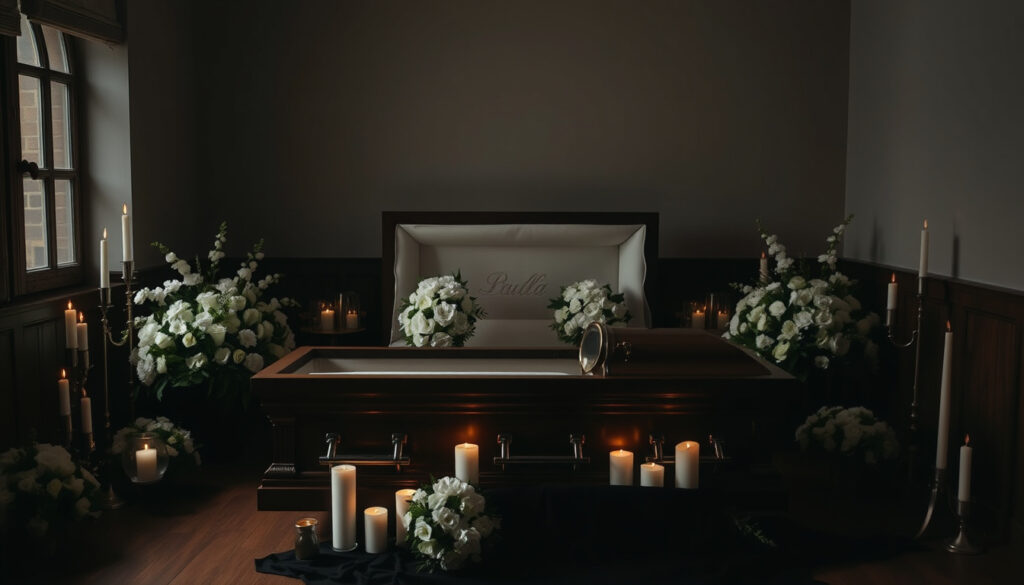
Funeral Wake: Definition, Origins & Etiquette
There’s something quietly powerful about gathering to keep watch over the dead. The funeral wake, a tradition that spans centuries and cultures, is more than just a social call — it’s a ritual that says “you are not alone in this moment.”
Traditional visiting hours: 5pm to 8pm ·
Colors to avoid at a funeral: 3 ·
Etymology root: Old English ‘wacan’ (to watch)
Quick snapshot
- The term “wake” derives from the practice of keeping vigil over the dead (Wikipedia (general encyclopedia)).
- Wakes are common in Catholic and Irish traditions (National Catholic Register (Catholic news outlet)).
- Attire for a funeral wake is generally dark and subdued (The Gardens (funeral services blog)).
- The exact origins of the Irish wake are debated among historians (The Gardens).
- Whether the first wakes were Christian or pre‑Christian is uncertain (The Gardens).
- First recorded use: 12th century (Old English “wacan”) (Merriam‑Webster (dictionary authority)).
- Traditional wakes were held in the family home for one or two days (Wikipedia). (Merriam‑Webster (dictionary authority))
- Modern wakes increasingly take place in funeral homes or church halls (Evans Funeral Chapel (funeral home)).
- Personalized music and themed services are becoming common at modern wakes (The Gardens).
- Virtual attendance options are being expanded by many funeral homes (Evans Funeral Chapel).
Four key facts, one pattern: the wake has evolved from a practical vigil into a cultural institution that balances mourning with community.
| Fact | Value |
|---|---|
| First recorded use | 12th century (Old English “wacan”) |
| Typical duration | 2–4 hours, often evening |
| Common location | Funeral home, family home, or church hall |
| Colors to avoid | Red, yellow, white |
Why is a funeral called a wake?
What does wake mean?
- The word “wake” comes from the Old English wacan, meaning “to watch” or “to keep vigil” (Merriam‑Webster).
- Medieval communities would stay awake through the night to guard the deceased from disturbance — and to confirm the person had actually died (National Catholic Register).
Why do the Irish call it a wake?
- Irish tradition places strong emphasis on the “watching” aspect — family and friends kept vigil in the home for one or two days (Wikipedia).
- Some historians connect the custom to older Celtic practices, though the exact origin remains debated (The Gardens).
Why do Catholics call it a wake?
- The Catholic Church integrated the wake with prayers such as the Rosary, recited collectively for the soul of the deceased (Wikipedia).
- A Catholic‑oriented wake often includes a crucifix and holy water beside the coffin (National Catholic Register).
The pattern: Three traditions — linguistic, folk, and liturgical — all converged on the same practice: staying awake with the dead. The word survived because the action it described remained essential.
TL;DR: Old English, Irish custom, and Catholic liturgy each shaped the wake’s name and purpose. All three traditions kept the vigil alive.
For anyone planning a wake, the historical roots explain why the event can feel both solemn and social. The wake was never meant to be purely sad — it was a shared watch, not a solo grief.
What is a funeral wake?
What is an Irish wake?
- An Irish wake is a social gathering held before the funeral, typically in the family home, with food, drink, storytelling, music, and dancing (Wikipedia).
- Traditional details include covering mirrors, stopping clocks, opening windows, and keeping candles lit (Wikipedia).
Is wake a word for funeral?
- No — “wake” refers to the visitation or vigil, while “funeral” refers to the formal ceremony with burial or cremation (Evans Funeral Chapel).
- The wake can occur before or after the funeral service itself (Evans Funeral Chapel).
The implication: A wake and a funeral serve different emotional roles — one is intimate and unstructured, the other ritualized and final. Many people conflate them, but the distinction affects everything from timing to dress code.
TL;DR: A wake is a vigil with the body present; a funeral is a formal ceremony. The two are not interchangeable, though often held in sequence.
What is the difference between a wake and a funeral?
- A wake occurs before the funeral and is a time for visitation and remembrance, often with food and drink (Wikipedia).
- The funeral is a formal ceremony with burial or cremation, typically led by a clergy member or celebrant (Evans Funeral Chapel).
- Wakes are less formal and open to extended social circles; funerals are usually more structured and limited in time (The Gardens).
The trade‑off: Attending a wake allows you to connect with the family and share memories in a relaxed setting. A funeral demands more decorum but marks the final goodbye. Knowing which is which helps you choose the right behavior.
TL;DR: Wakes are casual and communal; funerals are solemn and structured. Both honor the deceased, but in different tones.
What 3 colors not to wear to a funeral?
- Bright colors — especially red, yellow, and white — are traditionally avoided at funerals in Western cultures (Irish Urns (specialist cultural site)).
- Black, navy, grey, and other dark tones are considered appropriate (The Gardens).
- At Irish wakes specifically, flamboyant or loud colors are discouraged (Irish Urns).
The catch: These rules are cultural, not universal. In some traditions white is the mourning color, and in others red is celebratory. When in doubt, ask the family or check the invitation.
TL;DR: Avoid red, yellow, and white at Western funerals. Stick to dark, subdued clothing unless the family indicates otherwise.
Even a well‑intentioned guest can cause offense with the wrong color. A simple rule: if the item draws attention to itself, save it for another occasion.
What is the saddest song to play at a funeral?
- Commonly requested songs include “Tears in Heaven” (Eric Clapton), “Hallelujah” (Leonard Cohen / Jeff Buckley), and “My Heart Will Go On” (Céline Dion) (The Gardens).
- Traditional Irish wake music often features slow airs and laments played on fiddle or uilleann pipes (Wikipedia).
- The choice ultimately depends on the deceased’s personal taste and cultural background (Evans Funeral Chapel).
The upshot: Music at a wake is more than background — it sets the emotional tone. A song that meant something to the person who died can turn a generic service into a genuinely personal one.
TL;DR: Popular sad songs include “Tears in Heaven” and “Hallelujah.” But the best choice is one that resonated with the deceased.
“A wake is a vigil or gathering held before a funeral, centered on keeping watch over the deceased.”
Wikipedia (general encyclopedia)
“The original purpose of a wake was to ensure that the person was actually deceased.”
National Catholic Register (Catholic news outlet)
“The 1660 Synod of Tuam condemned common wake practices including obscene songs and suggestive games.”
Catholic World Report (religious affairs magazine)
For anyone planning or attending a wake in the English‑speaking world, the lesson is clear: embrace the paradox. The wake is simultaneously a sad farewell and a communal gathering, a vigil and a party. The best approach is to follow the family’s lead — if they’re telling stories, listen; if they’re serving tea, stay a while. The tradition has survived for centuries because it works: it turns a solitary death into a shared experience.
farewells.co.uk, after.com, altogetherfuneral.com, facebook.com, shows.acast.com, memorials.com, youtube.com
For those interested in the broader cultural meanings of ‘wake up’, the broader cultural meanings of wake up explores its use in grammar, song, and film.
Frequently asked questions
How long does a typical wake last?
Most wakes last 2–4 hours, often held in the evening from about 5pm to 8pm (Evans Funeral Chapel).
Do you bring food to a wake?
In many traditions, guests bring food or drink to share with the family. It’s a practical gesture of support (The Gardens).
Is a wake the same as a viewing?
Generally yes — both involve an open coffin and a chance for visitors to pay respects. “Viewing” sometimes refers to a shorter, more formal visit (Wikipedia).
What do you say to someone at a wake?
Simple condolences are fine: “I’m sorry for your loss” or “I have such fond memories of [name].” Avoid lengthy stories unless the family invites them (The Gardens).
Can children attend a wake?
Yes, though parents should prepare them for the open coffin and the emotional atmosphere. Many families welcome children (Evans Funeral Chapel).
What is the difference between a wake and a memorial service?
A wake usually involves the body present; a memorial service may be held later, with or without cremated remains, and focuses on celebration of life (Wikipedia).
Do you have to be Catholic to have a wake?
No. Wakes are held across Christian denominations and in non‑religious contexts. The practice is cultural as much as religious (Wikipedia).
What is the proper attire for a wake?
Dark, conservative clothing is standard. Avoid bright colors, flashy patterns, or anything that draws attention (Irish Urns).
More related posts
 Joanna Garland: Biography, Ranking, and Career Highlights
 Belle Delphine: What Happened, Controversies & 2025 Status
 The Crowded Room: True Story, Twist, and Tom Holland’s Break
 Jesinta Franklin: Marriage, Baby Name, Age, Beauty Secrets & More
 Weekly Tax Table 2025 – Official IRS Guide for Employers
 Miranda Tapsell: Background, Kids, Top End Bub, Career
 Honey Soy Chicken: Easy Sticky Recipe with Marinade & Tips
 Jasmine Rice: How to Cook, Health Benefits, vs Basmati & White
