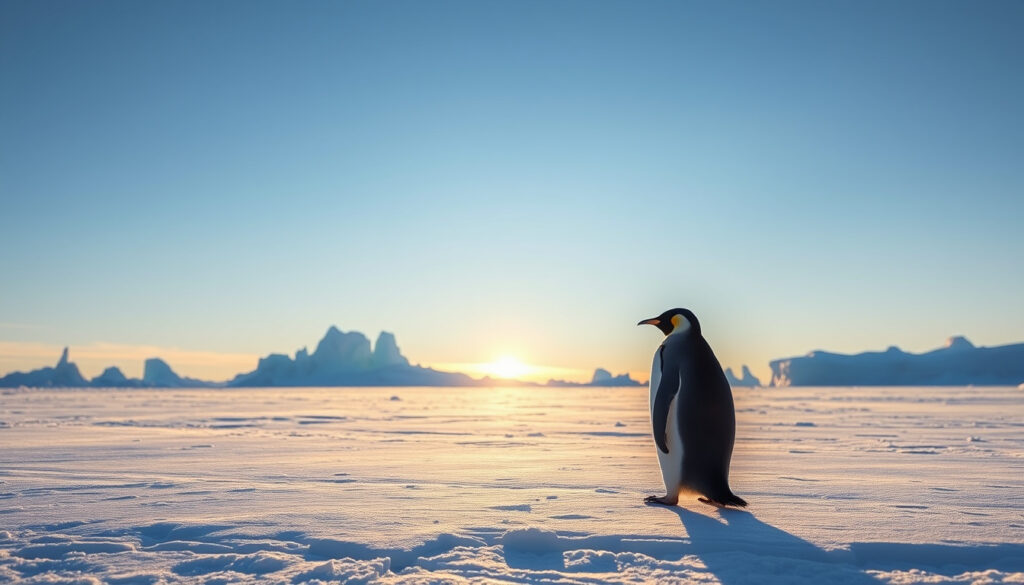
Emperor Penguin: Facts, Size, Habitat, and Conservation
If you’ve ever seen a penguin waddle across ice, you might think you know what they’re all about. But emperor penguins take that familiar image and flip it on its head—they breed in the dead of Antarctic winter, a feat no other bird attempts.
Height: Up to 125 cm (49 in) ·
Weight: Up to 45 kg (99 lb) ·
Lifespan: 15–20 years in wild ·
Population trend: Decreasing (IUCN Near Threatened)
Quick snapshot
- Emperor penguins are the tallest and heaviest penguin species (WHOI FLEDGE Lab)
- They breed exclusively on Antarctic sea ice (Communications Earth & Environment)
- Exact population decline rate over the next 50 years (Nature Communications)
- Impact of growing tourism on individual colonies (Nature Communications)
- 2012: IUCN listing as Near Threatened (PMC article)
- 2022: Catastrophic breeding failure linked to record-low sea ice (Communications Earth & Environment)
Emperor penguins are not just the largest penguin—they are the only bird that breeds in Antarctic winter. That unique strategy now faces an existential threat: the sea ice they depend on is vanishing faster than scientists predicted.
Key facts about emperor penguins
Three numbers define this species: height, weight, and the ice they need to survive.
| Attribute | Value |
|---|---|
| Scientific name | Aptenodytes forsteri |
| Height | Up to 125 cm |
| Weight | Up to 45 kg |
| Diet | Fish, krill, squid |
| Population | ~600,000 breeding pairs |
| Lifespan | 15–20 years in the wild |
| IUCN status | Near Threatened (since 2012) |
| Main threat | Climate-driven sea ice loss |
What is special about emperor penguins?
Unique physical traits
- Emperor penguins are the largest living penguin species, reaching up to 125 cm in height (WHOI FLEDGE Lab).
- They have distinctive yellow patches on the neck and ear area, unique among penguins.
Breeding cycle in winter
- Emperor penguins breed during the Antarctic winter (March–December) on sea ice, timing their cycle to match ice formation and spring breakup (Environments.aq PDF).
- Females lay a single egg, which the male incubates on his feet for about 65 days, fasting the entire time.
Diving and swimming abilities
- Emperor penguins are exceptional divers, reaching depths of up to 500 meters (1,640 ft) and staying underwater for over 20 minutes (Encyclopaedia Britannica).
- Their robust bodies and streamlined wings make them powerful swimmers, capable of chasing fish and squid.
Which penguin is bigger, king or emperor?
Size comparison: emperor vs king
Two species stand out among penguins: emperor and king. One key pattern: emperor penguins are consistently larger.
| Trait | Emperor penguin | King penguin |
|---|---|---|
| Height | Up to 125 cm | Up to 95 cm |
| Weight | Up to 45 kg | Up to 18 kg |
| Plumage | Black and white with yellow neck patches | Black and white with vibrant orange-yellow patches |
| Breeding location | Antarctic sea ice | Sub-Antarctic islands (South Georgia, etc.) |
| Breeding season | Winter (March–December) | Year-round, 14–16 months per cycle |
| IUCN status | Near Threatened | Least Concern |
Weight differences
- Emperor penguins can weigh up to 45 kg, about 2.5 times the weight of a king penguin (WHOI FLEDGE Lab).
- King penguins are the second-largest penguin species but are much lighter and less stocky.
Geographic range differences
- Emperor penguins are endemic to Antarctica—they breed on coastal pack ice (Encyclopaedia Britannica).
- King penguins inhabit sub-Antarctic islands with milder conditions and access to open water year-round.
The implication: emperor penguins are not only bigger but also more specialized for extreme cold, while king penguins live in a more temperate zone.
Size is a trade-off: larger body mass helps emperor penguins endure winter fasting, but it also means they need more food and stable ice to raise chicks.
Why are emperor penguins going extinct?
Climate change impacts
- Climate-driven loss of Antarctic sea ice is the central threat to emperor penguins (Nature Communications).
- A 2017 study projected that emperor penguin numbers could fall by up to 19% by 2100 under warming scenarios (Science).
Sea ice loss
- In 2022, a record-low sea ice year caused catastrophic breeding failure in several colonies (Communications Earth & Environment).
- A 2025 satellite study found that 16 colonies in one region declined by 22% between 2009 and 2024 (PBS NewsHour).
- Loss of sea ice before chicks fledge leads to high chick mortality (Communications Earth & Environment).
Conservation status
- The IUCN has listed emperor penguins as Near Threatened since 2012 due to projected climate-change impacts (PMC article).
- The U.S. Endangered Species Act now provides federal protections, reflecting the species’ vulnerability (WHOI FLEDGE Lab).
What this means: emperor penguins are not guaranteed to go extinct this century, but their survival hinges on how much and how fast the planet warms.
Are emperor penguins friendly?
Temperament in the wild
- Emperor penguins are generally not aggressive toward humans; they show curiosity and may approach slowly (Encyclopaedia Britannica).
- In breeding colonies, they tolerate close observation but will defend their egg or chick if threatened.
Interaction with humans
- Researchers and documentary crews describe them as calm and unafraid, unlike more skittish penguin species.
- Tourism in Antarctica is regulated to minimize disturbance, but increased visitation could alter penguin behavior.
Breeding colony behavior
- Emperor penguins form large colonies of thousands of pairs, huddling together to survive the cold (Environments.aq PDF).
- They communicate with distinct calls to locate mates and chicks amid the crowd.
The catch: “friendly” is a human label—emperor penguins are simply not conditioned to fear land predators, which is why they appear calm.
What is a sad fact about penguins?
Parental sacrifice
- Male emperor penguins incubate the single egg on their feet for about 65 days, fasting and losing up to half their body weight.
- Females must travel hundreds of kilometers to the sea to feed, then return to relieve the male and feed the chick.
Chick mortality risks
- Chicks face high mortality from cold exposure, especially when sea ice breaks up early (Communications Earth & Environment).
- In years of low sea ice, entire colonies can lose all chicks before they fledge.
Harsh environment
- Emperor penguins endure temperatures below -50°C and winds over 200 km/h during winter breeding.
- Despite their adaptations, climate change is making their environment even more punishing.
The pattern: emperor penguins evolved to survive the worst nature can throw at them, but they cannot outrun human-driven warming.
Emperor penguin timeline: conservation milestones
| Period | Event |
|---|---|
| Early 20th century | First scientific documentation of emperor penguin colonies |
| 1970s | First large-scale population surveys conducted |
| 2012 | IUCN lists species as Near Threatened (PMC article) |
| 2022 | Record-low Antarctic sea ice triggers breeding failure (Communications Earth & Environment) |
| 2025 | Satellite study reveals 22% regional decline in 15 years (PBS NewsHour) |
| Recent years | Climate models project continued population declines (Nature Communications) |
Why this matters: the timeline shows a clear acceleration of threat signals—from distant projections to documented breeding failures in under two decades.
Confirmed facts vs. what’s unclear
Confirmed facts
- Emperor penguins are the largest living penguin species (WHOI FLEDGE Lab)
- They breed exclusively on Antarctic sea ice (Communications Earth & Environment)
- Climate change is the primary threat (Nature Communications)
- Sea ice loss has already caused colony failures (Communications Earth & Environment)
- IUCN status: Near Threatened since 2012 (PMC article)
What’s unclear
- Exactly how fast the global population will decline over the next 50 years
- Whether some colonies may adapt by shifting to different ice conditions
- The full impact of tourism and research activity on colony health
What experts say
“Climate change is increasingly recognized as one of the most serious threats to emperor penguin populations, primarily through its impact on sea ice.”
“The emperor penguin’s breeding strategy is exquisitely tuned to the Antarctic winter, but that same specialization makes it extraordinarily vulnerable to shifts in sea ice timing and extent.”
— Australian Antarctic Division, Australian Antarctic Division (government research agency)
For anyone who cares about Antarctic wildlife, the choice is clear: without steep emissions cuts, emperor penguins face a future of shrinking ice and shrinking numbers. The alternative—protecting enough sea ice habitat—requires global climate action that matches the scale of the threat.
Understanding the full scope of emperor penguin extinction threats provides crucial context for the species’ conservation challenges.
Frequently asked questions
What is the scientific name of the emperor penguin?
Aptenodytes forsteri.
How tall do emperor penguins get?
Up to 125 cm (49 inches), making them the tallest penguin species.
What do emperor penguins eat?
Fish, krill, and squid, caught during deep dives.
How long do emperor penguins live?
15–20 years in the wild, though some individuals reach 30 years.
Where do emperor penguins live?
They are endemic to Antarctica, breeding on coastal pack ice.
Do emperor penguins fly?
No, they are flightless but are exceptional swimmers and divers.
Are emperor penguins endangered?
They are listed as Near Threatened by the IUCN, and climate change is driving population declines.
How do emperor penguins keep warm?
They huddle together in tightly packed groups, rotating positions to share warmth, and have dense feather layers and a thick fat layer.
More related posts
 Miranda Tapsell: Background, Kids, Top End Bub, Career
 Malcolm Todd: Biography, Age, Music, Tour & Family Rumors
 Linda McCartney: Her Life, Death, and Lasting Legacy
 Emma Chambers: Cause of Death, Health Issues, and Legacy
 Mr. Krabs Character Analysis: Good or Bad? Full Profile
 Ralph Lauren Sweaters: Best Styles, Sizing & Care Tips
 Chiwetel Ejiofor: Biography, Partner, Scar, Net Worth, and Movies
 Dwayne Johnson: Height, Ethnicity, Wife & Net Worth
