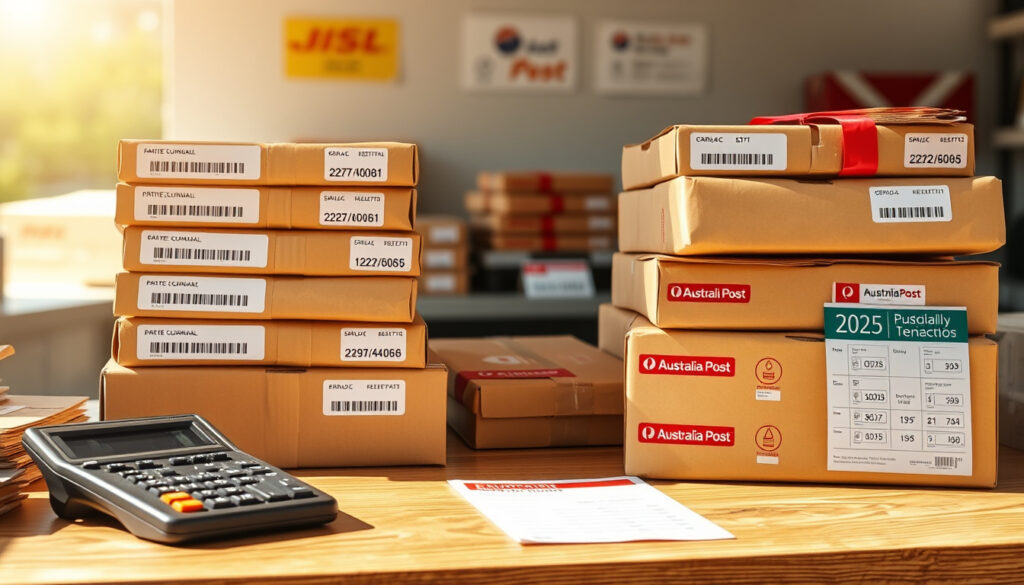
Australia Post Parcel Rates 2025: Costs, Sizes & Calculator
Australia’s postage system catches many senders off guard: flat fees apply to parcels up to 5kg, but anything heavier shifts to zone-based charging that varies by distance. This guide breaks down the official 2025 Australia Post pricing for domestic and international parcels, with tools to calculate any route yourself.
Parcels up to 5kg: Fixed price to anywhere in Australia · Parcel Post service: Regular domestic delivery · Express add-on: $17 at each standard price point · Courier add-on: $85 at each standard price point · Postage calculator: Calculate your rate on auspost.com.au
Quick snapshot
- Domestic Parcel Post flat rates up to 5kg cost $9.70–$23.30 depending on size (Australia Post Parcel Post Guide MS102)
- Domestic rates effective as at 1 July 2025 (Australia Post Parcel Post Guide MS102)
- Maximum domestic weight is 22kg per parcel (Australia Post Parcel Post Business Page)
- Exact 2025 prices for international parcels over 5kg without using the calculator
- Specific zone definitions and distance charge tables for all domestic zones beyond samples shown
- Whether peak season surcharges apply in addition to the documented rates
- New domestic rates and extra small packaging launched 1 July 2025 (Australia Post MS11 Post Charges Booklet)
- Extra small satchels became available 1 August 2025 (Australia Post MS11 Post Charges Booklet)
- International updates noted for 1 October 2025 (Australia Post MS11 Post Charges Booklet)
- Australia Post’s official postage calculator handles any route, weight, or destination automatically (Australia Post Postage Calculator)
- MyPost Business account holders can access spend-band discounts on both domestic and international services (Australia Post MyPost Business Rates Guide)
| Label | Value |
|---|---|
| Up to 5kg parcels | Fixed price Australia-wide |
| Express Parcel add-on | $17 extra |
| Courier Parcel add-on | $85 extra |
| Official calculator | auspost.com.au/parcels-mail/calculate-postage-delivery-times/ |
| Domestic max weight | 22kg |
| International max weight | 20kg |
| MyPost Business flagfall (first 5kg) | $31.80 |
How much does it cost to post a parcel in Australia?
Australia Post breaks domestic pricing into two distinct zones: parcels up to 5kg travel at a fixed nationwide rate regardless of where they’re going, while anything heavier shifts to zone-based charging with distance components. According to Australia Post’s Parcel Post Guide MS102, postage for articles up to 5kg is a fixed price to anywhere in Australia.
Domestic parcels up to 5kg
For senders using their own packaging, the flat-rate scale runs as follows: up to 250g costs $9.70, 250–500g costs $11.15, 500g–1kg costs $15.25, 1–3kg costs $19.30, and 3–5kg costs $23.30 (Australia Post Parcel Post Business Page). Prepaid satchels carry a small markup—Extra small $10.05, Small $11.50, Medium $15.65, Large $19.75, Extra large $23.80—but the pricing logic remains identical: size-based, not weight-based.
- Up to 250g: $9.70
- 250–500g: $11.15
- 500g–1kg: $15.25
- 1–3kg: $19.30
- 3–5kg: $23.30
Parcels over 5kg
Once a parcel exceeds 5kg, the pricing model changes. Australia Post charges on either the actual weight or the cubic weight (volume in cubic metres multiplied by 250), whichever is greater. The base charge is $23.30 to cover the first 5kg, then distance-based fees kick in per additional kilogram (Australia Post Parcel Post Guide MS102). For example, a 5–6kg parcel destined for Queensland Zone 3 costs $25.25, while the same weight sent to Tasmania Zone 1 runs $25.70—a difference that reflects geographic distance rather than parcel size.
A bulky but light box could cost significantly more than a dense, heavy parcel because cubic weight is calculated as (length × width × height) × 250 kg/m³. For lightweight large items, flat-rate packaging may genuinely be the cheaper option.
Using own packaging
The same flat-rate brackets apply whether you use Australia Post boxes or your own boxes, provided your parcel stays within the 105cm length limit, 0.25 cubic metre volume cap, and 22kg weight ceiling (Australia Post Parcel Post Business Page). The critical difference with own packaging is compliance: your box must meet structural standards and must not exceed the dimensional limits or Australia Post may re-weigh and re-price the parcel at the counter.
Does Australia Post go by weight or size?
For parcels up to 5kg, the answer is straightforward: size, not weight. Flat-rate pricing locks in the cost regardless of how much the parcel actually weighs within that size tier. Above 5kg, both metrics matter—Australia Post will assess charges according to their actual weight or cubic weight equivalent, whichever is greater (Australia Post Parcel Post Guide MS102).
Weight-based pricing
The cubic weight formula rewards dense, compact parcels and penalises large, lightweight ones. If you have a 1kg parcel in a 30cm × 30cm × 20cm box, the cubic weight calculation is (0.30 × 0.30 × 0.20) × 250 = 4.5kg. Australia Post would charge based on 4.5kg, not the actual 1kg. This is why many senders discover their “light” parcel costs more than expected—the box dimensions drive the price.
Size limits for parcels
Domestic parcels cannot exceed 105cm in any single dimension, and the sum of length plus twice the width plus twice the height (girth) cannot surpass 140cm. The total volume is capped at 0.25 cubic metres (Australia Post Parcel Post Business Page). Packages that exceed these limits are either returned to sender or upgraded to a higher charge tier, depending on the specific dimensions.
Parcel dimensions guide
Australia Post’s official flat-rate packaging comes in five named sizes: XS (up to 250g), S (up to 500g), M (500g–1kg), L (1–3kg), and XL (3–5kg). Extra small satchels were introduced from 1 July 2025 at $9.70 postage only, with the prepaid satchel version added 1 August 2025 at $10.05 (Australia Post Parcel Post Business Page). These pre-sized options eliminate the guesswork around dimensional weight since the boxes themselves are pre-certified.
What are Australia Post parcel sizes and prices?
Australia Post publishes detailed rate cards in PDF format, with the current domestic Parcel Post Guide MS102 effective as at 1 July 2025 and the MS11 Post Charges Booklet reflecting rates from 17 July 2025 (Australia Post MS11 Post Charges Booklet). These documents contain the full zone maps and specific distance charge tables.
Standard parcel sizes
The official flat-rate boxes and satchels are designed around practical weight brackets rather than exact dimensions. The XS satchel accommodates items up to 250g, S up to 500g, M handles 500g to 1kg, L covers 1–3kg, and XL takes 3–5kg. This structure means a sender doesn’t need to measure dimensions precisely—weight determines the appropriate tier.
Flat rate packaging
Australia Post offers two service levels for flat-rate packaging: Regular Parcel Post and Express Post. The Express version adds a premium across all sizes: Extra small $12.70, Small $14.65, Medium $19.25, Large $23.80, XL $31.80 (Australia Post Flat Rate Packaging Page). The price difference is consistent at $3 for XS through to $8.50 for XL, reflecting the speed premium rather than dimensional differences.
This table shows the direct comparison between standard and express pricing for each size tier.
| Size tier | Regular Parcel Post | Express Post | Difference |
|---|---|---|---|
| Extra small (up to 250g) | $9.70 | $12.70 | +$3.00 |
| Small (up to 500g) | $11.15 | $14.65 | +$3.50 |
| Medium (500g–1kg) | $15.25 | $19.25 | +$4.00 |
| Large (1–3kg) | $19.30 | $23.80 | +$4.50 |
| XL (3–5kg) | $23.30 | $31.80 | +$8.50 |
The implication: the premium for Express Post grows disproportionately at higher weight tiers, so heavier parcels may benefit more from comparing Express against zone-based pricing for the speed gain.
20kg parcel costs
A 20kg domestic parcel sits at the maximum weight limit (domestic max is 22kg) and would be priced using the zone-based system. The base charge of $23.30 covers the first 5kg, then zone-specific per-kilogram rates apply for the remaining 15kg. For a metro-to-metro route like Sydney to Brisbane, expect around $35–$40; for regional routes to more remote zones, costs climb toward $50–$60 based on sample zone pricing in the official guide. The exact figure depends on your specific zone, which the Australia Post Postage Calculator will compute automatically.
Does Australia Post deliver to Ireland?
Yes—Australia Post offers international parcel services to Ireland through its International Standard Parcel and Express Parcel options, with rates varying by destination zone and weight. International parcels can weigh up to 20kg with a maximum length of 105cm and girth of 140cm (Australia Post MS11 Post Charges Booklet).
Delivery times to Ireland
International Standard Parcel to Western Europe typically takes 10–15 business days, while Express Parcel reduces this to 3–7 business days depending on customs processing. Economy Air Parcel is available for lighter packages up to 2kg and is approximately $2.00 cheaper than Standard Parcel at each weight point (Australia Post International Post Charges Guide).
Costs for international parcels
International pricing follows a zone structure rather than a flat national rate. The base pricing starts at $19.65 for items up to 250g to Zone 1 destinations (NZ and Pacific), with costs climbing through subsequent zones. For Ireland specifically (likely Zone 4 or 5), rates are substantially higher than domestic pricing—a 3kg international parcel can easily cost $80–$120 depending on service level. MyPost Business account holders may access up to 35% discounts on certain international zones (Australia Post MyPost Business Rates Guide).
Customs and duty requirements
All international parcels require customs documentation regardless of value. The sender must complete a customs declaration form listing the contents, value, and purpose (gift, commercial, or personal). For inbound parcels to Australia, duty and GST may apply if the declared value exceeds the threshold. Parcels from Australia to Ireland are subject to Irish import regulations, which may include VAT and customs duties on the recipient’s end. Third-party platforms like Easyship international comparator can provide comparative international rates alongside Australia Post pricing.
International parcel costs exclude GST from Australian-side pricing, but recipients in Ireland will typically face import VAT and may owe customs duties on commercial shipments. This cost lands on the receiver, not the sender—so international senders should factor this into customer expectations.
Is DHL faster than Australia Post?
For international deliveries, DHL typically offers faster transit times than Australia Post’s international services, particularly for premium express routes. However, the comparison depends heavily on the specific destination, weight, and service tier being considered.
Delivery speed comparison
DHL Express services to major global cities often deliver within 2–5 business days, while Australia Post Express Parcel typically runs 3–7 business days to similar destinations. Standard Australia Post International Parcel stretches to 10–20 business days for many Western destinations. The speed gap narrows considerably for regional areas where DHL’s network density advantage is smaller, and Australia Post’s universal reach can actually match or exceed competitor delivery times to remote addresses.
International rates comparison
Australia Post international pricing follows a zone-based structure with Express adding $17 to each Standard Parcel price point and Courier adding $85 (Australia Post International Post Charges Guide). DHL generally charges higher base rates but includes more comprehensive tracking and customs clearance services in the base price. Third-party aggregators like Easyship allow side-by-side comparison of Australia Post against DHL, UPS, and FedEx rates for specific routes.
When to choose each
Choose Australia Post for cost-sensitive domestic and lighter international parcels where tracking visibility is sufficient and delivery speed is not critical. Choose DHL for time-sensitive commercial shipments to major cities where the speed premium and customs handling justify the higher cost. MyPost Business account holders accessing the 35% international discount on certain zones (Australia Post MyPost Business Rates Guide) may find Australia Post’s express international pricing competitive with third-party carriers even for time-sensitive shipments.
For domestic Australian deliveries, Australia Post’s flat-rate structure is almost always the most cost-effective option. For international shipping, the choice between Australia Post and carriers like DHL hinges on whether the speed difference justifies the cost premium for your specific route and urgency level.
Confirmed facts
- Domestic Parcel Post flat rates up to 5kg apply nationwide at fixed prices ($9.70–$23.30)
- Domestic rates effective as at 1 July 2025 per official Australia Post guide documents
- Own packaging priced identically to flat-rate packaging for parcels up to 5kg
- Parcels over 5kg charged on actual or cubic weight, whichever is greater
- Express Post adds $17 at each price point; Courier adds $85
- International max weight is 20kg; domestic max is 22kg
- MyPost Business offers spend-band discounts on both domestic and international services
What remains unclear
- Exact international rates for parcels over 5kg to specific countries without using the calculator
- Complete zone maps and distance charge tables for all domestic zones beyond the sample zones documented
- Whether peak season surcharges or fuel adjustments apply beyond the documented rates
- Specific zone classifications for all international destinations beyond the zone groupings
How to calculate Australia Post parcel rates
Australia Post provides a free online postage calculator that handles domestic and international routes, service types, and weight combinations automatically. The Australia Post Postage Calculator is the authoritative tool for any route not explicitly documented in rate sheets.
- Visit auspost.com.au/parcels-mail/calculate-postage-delivery-times/
- Select “Domestic” or “International” depending on your shipment
- Enter the origin and destination postcodes
- Choose the service type (Parcel Post, Express Post, etc.)
- Input either the exact weight or dimensions—calculator computes both if dimensions are provided
- Review the price options across service tiers
“Postage for articles up to 5kg is a fixed price to anywhere in Australia.”
— Australia Post, Parcel Post Guide MS102
“Australia Post will assess charges according to their actual weight or cubic weight equivalent, whichever is greater.”
— Australia Post, Parcel Post Guide MS102
Related reading: Commonwealth Bank Term Deposit Rates – 2026 Rates and Guide · Bank Australia Login – Official Guide to Secure Access
auspost.com.au, auspost.com.au, auspost.com.au, auspost.com.au, auspost.com.au, auspost.com.au
Australia Post’s 2025 domestic rates guide outlines fixed domestic pricing up to 5kg alongside zone-based charges for heavier parcels to 22kg in 2025.
Frequently asked questions
How much to send a 20kg parcel to Australia?
A 20kg parcel within Australia costs more than the flat-rate ceiling, so pricing depends on your specific zone. The base charge is $23.30 plus zone-based distance charges for the 15kg above the included 5kg. Expect roughly $35–$60 depending on whether you’re shipping metro-to-metro or to a remote zone. Use the Australia Post Postage Calculator for an exact quote based on your route.
How much does it cost to send a 3kg parcel in Australia?
A 3kg parcel sent domestically within Australia costs $19.30 using Parcel Post flat-rate pricing. This applies whether you use Australia Post packaging or your own box, provided the parcel stays within the 1–3kg weight bracket and dimensional limits.
What is Australia Post Parcel Post?
Parcel Post is Australia Post’s standard domestic parcel service featuring fixed pricing for parcels up to 5kg and zone-based charging for heavier parcels. It’s the most cost-effective option for non-urgent domestic deliveries and includes tracking through the Australia Post network.
How to calculate Australia Post parcel rates?
The official Australia Post postage calculator at auspost.com.au/parcels-mail/calculate-postage-delivery-times/ handles any combination of origin, destination, weight, dimensions, and service type. Enter your details and the tool returns all available service options with pricing.
What are the max sizes for Australia Post parcels?
Domestic parcels max out at 22kg weight, 105cm length, and 0.25 cubic metres volume. International parcels are limited to 20kg, 105cm length, and 140cm girth. Parcels exceeding these limits may be refused or incur upgrade charges.
Do international parcels require customs forms?
Yes—all international parcels require customs documentation regardless of declared value. The sender must complete a customs declaration form listing contents, value, and purpose. This applies to all destinations outside Australia.
What if I use own packaging for Australia Post?
Own packaging qualifies for the same flat-rate pricing as Australia Post boxes for parcels up to 5kg, provided it meets dimensional limits (105cm max length, 0.25m³ max volume). Above 5kg, cubic weight applies regardless of packaging type. Your packaging must be structurally sound and cannot exceed the girth limits.
Are there fixed rates for Australia Post parcels over 5kg?
No—parcels over 5kg shift to zone-based pricing with distance charges per kilogram. The $23.30 base covers the first 5kg, then zone-specific rates apply for each additional kilogram. The exact cost varies by your specific origin and destination zones.
For small business owners regularly shipping parcels, the choice between standard Parcel Post and a MyPost Business account is worth examining closely. MyPost Business offers a flagfall of $31.80 for the first 5kg (standard rate, discounted to $26.24 at the highest spend band) plus distance charges (Australia Post MyPost Business Rates Guide). If your monthly shipping volume exceeds a few dozen parcels, the spend-band discounts alone could reduce your annual postage bill by hundreds of dollars—making the annual fee for a Return Paid Number at $135.00 a minor cost against the savings on bulk postage.
More related posts
 American Express Travel – Complete Guide to Portal and Benefits
 Big John: British TikTok Star Detained in Australia
 James Nelson-Joyce: Biography, Net Worth, Height, and Movies
 Marie Curie: Discoveries, Death, and Radioactive Legacy
 Eugenia Cooney: Biography, Twitch Ban, Net Worth, and Rumors
 Winnie the Pooh Characters: Friends, Neurodiversity & Facts
 Kevin Federline: Life, Career, and New Memoir
 John Howard: Biography, Policies, Legacy of Australia’s 25th PM
