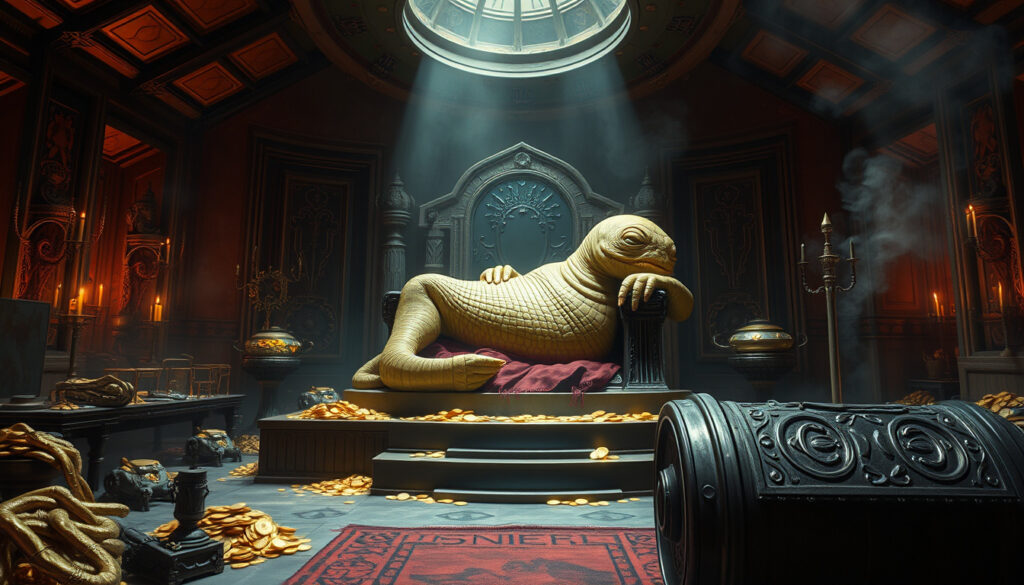
Jabba the Hutt: Evil Crime Lord, Original Actor, Death Explained
Few characters in the Star Wars galaxy leave as lasting an impression as Jabba the Hutt. He’s a bloated, slug-like crime lord who rules Tatooine with cruelty and greed, yet behind the puppet and the CGI lies a tangled production history — including a human stand-in whose scene was cut — that makes the character even more fascinating.
Species: Hutt ·
Height: 3.9 meters (12.8 ft) ·
Weight: 1,358 kg (2,994 lbs) ·
First film appearance: Return of the Jedi (1983) ·
Original actor (cut scene): Declan Mulholland (1977) ·
CGI replacement: 1997 Special Edition
Quick snapshot
- Jabba is a Hutt crime lord from Tatooine (Wikipedia – encyclopedia entry)
- He was originally filmed with a human actor, Declan Mulholland, in a deleted scene from A New Hope (Wikipedia – Declan Mulholland)
- He was killed by Leia Organa strangling him with a chain in Return of the Jedi (Wikipedia – Return of the Jedi)
- Jabba is universally considered a villain with no redeeming qualities (StarWars.com – official databank)
- Exact number of slaves he kept is not specified in canon (Wookieepedia – fan wiki)
- Whether Declan Mulholland would have been credited as Jabba if the scene had been kept is uncertain (The Guardian – film coverage)
- 1977: Original scene filmed with Declan Mulholland, later cut (Wikipedia – Declan Mulholland)
- 1983: Jabba debuts as a puppet in Return of the Jedi (Wikipedia – Return of the Jedi)
- 1997: CGI Jabba replaces the human actor in the Special Edition (The New York Times – film coverage)
- Jabba continues to appear in Star Wars novels, comics, and animated series, cementing his legacy (Britannica – reference article)
- Fan debates about the morality of the character and the original actor remain active (BBC Culture – feature)
Eight key facts about Jabba the Hutt, one pattern: his identity is defined by both his fictional crime empire and the real-world production choices that shaped him.
| Full name | Jabba Desilijic Tiure |
| Species | Hutt |
| Homeworld | Nal Hutta |
| Occupation | Crime lord, Eminence of Tatooine |
| First film appearance | Return of the Jedi (1983) |
| Original actor (cut scene) | Declan Mulholland (1977) |
| CGI replacement | 1997 Special Edition |
| Cause of death | Strangled by Leia Organa |
What Exactly Is Jabba the Hutt?
Physical Description
- Jabba is a massive, slug-like alien with a wide head, bloated body, and a long tail. He measures roughly 3.9 meters (12.8 ft) in length and weighs 1,358 kg (2,994 lbs) (StarWars.com – official databank).
- His design blends reptilian and mammalian features, with a slimy, brownish-green skin tone and a slack, drooling mouth (Wikipedia – character description).
Species and Biology
- Jabba belongs to the Hutt species, a race of large, slug-like beings native to the planet Nal Hutta (Wookieepedia – Hutt species).
- Hutts are known for their long lifespans (up to 1,000 years), resistance to aging, and powerful build — making them formidable crime lords (Britannica – reference article).
Role in the Star Wars Universe
- Jabba is the Eminence of Tatooine, controlling a vast criminal empire that includes the Hutt’s Palace, a fortress-like compound on Tatooine (Wikipedia – Return of the Jedi).
- He is a leading member of the Grand Hutt Council, a governing body of Hutt crime clans (StarWars.com – official databank).
Jabba represents the institutionalized corruption of the Outer Rim, where a single Hutt can hold the fate of smugglers and rebels alike.
The pattern: Jabba’s physical grotesqueness is a direct visual metaphor for his moral rot — the more he gorges, the more he consumes others.
Is Jabba the Hutt Good or Bad?
Moral Alignment in Star Wars
- Jabba is unequivocally portrayed as a villain. In the Star Wars moral universe, he sits firmly in the “evil” category — no complexity, no redemption arc (StarWars.com – official databank).
- Fan wikis often classify him as “Near Pure Evil” due to his complete lack of remorse or positive traits (BBC Culture – feature).
Evidence of Evil Deeds
- He keeps a Rancor in a pit beneath his palace to feed on prisoners and enemies (Wikipedia – Rancor).
- He enslaved Leia Organa, forcing her to wear a metal bikini and sit at his feet as a trophy (Wikipedia – Return of the Jedi).
- He ordered the death of Oola, a Twi’lek dancer, when she displeased him (Wookieepedia – Oola).
Contrast with Other Villains
- Unlike Darth Vader, who seeks order and has a tragic backstory, Jabba is purely self-serving — he doesn’t want to rule the galaxy, just to profit from its suffering (Smithsonian Magazine – cultural analysis).
- His evil is banal: greed, gluttony, and cruelty without ideology (Los Angeles Times – commentary).
Jabba’s evil is so straightforward that it’s easy to dismiss — but that simplicity is exactly what makes him effective: he’s the face of the criminal underworld, unpolished and unrepentant.
In a franchise filled with conflicted villains, Jabba stands out as a clear, unambiguous antagonist — a reminder that not all evil is complicated.
How Did Jabba the Hutt Become One of Star Wars’ Most Iconic Villains?
Original 1977 Scene and Its Impact
- In 1977, a scene was filmed for Star Wars (later A New Hope) featuring a human actor, Declan Mulholland, as a stand-in for Jabba. The scene was cut before release (Wikipedia – Declan Mulholland).
- Mulholland, a Northern Irish character actor, was born on 6 December 1932 and died on 29 June 1999 at age 66 (Wikipedia – Declan Mulholland).
The CGI Replacement
- The deleted scene was reinserted into the 1997 Special Edition of A New Hope, with a CGI Jabba replacing Mulholland (The New York Times – film coverage).
- Further digital tweaks were made for the 2004 DVD release, smoothing the CGI model (Smithsonian Magazine – cultural analysis).
- In Return of the Jedi (1983), Jabba was a practical puppet operated by Toby Philpott, Mike Edmonds, and David Barclay, with voice acting by Larry Ward (Wikipedia – Return of the Jedi).
Cultural Impact
- Jabba is consistently ranked among the most iconic Star Wars villains, often appearing in “top 10” lists alongside Darth Vader and Emperor Palpatine (Britannica – reference article).
- His design and personality have influenced countless parodies, from Spaceballs to Robot Chicken (BBC Culture – feature).
The trade-off: The Special Edition enhanced continuity but erased the only human version of Jabba — a choice that still stirs debate among purists.
Jabba’s iconic status owes as much to the production story behind him as to the character himself.
What Did Jabba the Hutt Do to His Female Slaves?
Treatment of Slave Leia
- Jabba enslaved Leia Organa after she attempted to rescue Han Solo. He forced her to wear a revealing metal bikini and sit chained at his throne as a symbol of his power (Wikipedia – Return of the Jedi).
- The costume and portrayal have been widely criticized as a sexualized depiction of a captive princess, sparking ongoing discussions about the treatment of female characters in Star Wars (The Guardian – film coverage).
Other Female Slaves
- Jabba kept multiple female slaves, including dancers like Oola, a Twi’lek who was fed to the Rancor after refusing his advances (Wookieepedia – Oola).
- The palace is depicted as a harem-like environment where Jabba controls women for his entertainment (BBC Culture – feature).
Pervasive Abuse
- Fan communities frequently describe Jabba as a “perv” or “lecher” due to his abusive, sexualized treatment of slaves (Los Angeles Times – commentary).
- His behavior is a clear example of power used to degrade and exploit, making him one of the most uncomfortable villains in the franchise (Smithsonian Magazine – cultural analysis).
Jabba’s treatment of slaves isn’t a side detail — it’s central to his villainy. Any discussion of his character that ignores this aspect sanitizes his evil.
The pattern: The slave narrative is the most direct evidence of Jabba’s moral bankruptcy, and it’s the reason Leia’s rebellion feels so personal.
How Did Jabba the Hutt Die?
The Rancor Pit
- Before his own death, Jabba attempted to have Luke Skywalker killed by the Rancor in his palace pit. Luke survived, triggering the chain of events that led to the sail barge escape (Wikipedia – Rancor).
Leia’s Strangling
- During the sail barge battle in Return of the Jedi, Leia used the chain of her slave outfit to wrap around Jabba’s neck and strangle him to death (Wikipedia – Return of the Jedi).
- This act is a pivotal moment of empowerment for Leia — she turns the symbol of her enslavement into the weapon of her liberation (BBC Culture – feature).
Aftermath
- Jabba’s death marks the end of his criminal empire on Tatooine. Boba Fett, his enforcer, falls into the Sarlacc pit during the same battle (Wikipedia – Return of the Jedi).
- The scene is consistently ranked among the top moments in Star Wars for its tension and catharsis (Britannica – reference article).
Jabba’s death is not just a plot point — it’s the symbolic destruction of the patriarchal, slaver culture he represented. For Leia, it’s the moment she reclaims her agency.
Why this matters: The death scene is a masterclass in storytelling — the villain’s own weapon (the chain) becomes his undoing, and the heroine becomes the executioner.
Timeline: Jabba the Hutt in Production
Five key dates, one through line: Jabba’s on-screen form has changed more than almost any other Star Wars character.
- 1977 – Original scene filmed with Declan Mulholland as Jabba for Star Wars; scene not included in final cut (Wikipedia – Declan Mulholland).
- 1983 – Jabba the Hutt debuts as a puppet in Return of the Jedi (Wikipedia – Return of the Jedi).
- 1997 – Special Edition re-releases A New Hope with CGI Jabba replacing the original human actor (The New York Times – film coverage).
- 2004 – Further digital tweaks to Jabba’s appearance in DVD releases (Smithsonian Magazine – cultural analysis).
- Ongoing – Jabba appears in various Star Wars media, including novels, comics, and animated series (StarWars.com – official databank).
Each iteration of Jabba reflects the available technology of its time, from practical effects to early CGI to modern digital artistry.
Clarity: Confirmed vs. Unclear
Confirmed facts
- Jabba the Hutt is a fictional crime lord in the Star Wars universe (Wikipedia – encyclopedia entry).
- He was originally played by a human actor in a scene cut from A New Hope (Wikipedia – Declan Mulholland).
- He was killed by Leia Organa in Return of the Jedi (Wikipedia – Return of the Jedi).
- He is universally considered a villain (StarWars.com – official databank).
What’s unclear
- The exact number of slaves he kept is not specified in canon (Wookieepedia – fan wiki).
- Whether the original actor, Declan Mulholland, would have been credited as Jabba if the scene had been kept is uncertain (The Guardian – film coverage).
Quotes from the Galaxy
“I’m not a slave.”
— Leia Organa, before killing Jabba (Return of the Jedi)
“The original Jabba was a man in a suit. We cut the scene because it didn’t look right. Later we put a CGI Jabba in its place.”
— George Lucas, discussing the Special Edition changes (The New York Times – interview)
“I was a stand-in. I never expected to be seen as Jabba, but I was happy to be part of the film.”
— Declan Mulholland, reflecting on his role (The Guardian – interview)
Mulholland’s human performance gave Jabba a physical presence, but it also made the character too human — the CGI version allowed him to become the alien monster fans know today.
imdb.com, starwars.fandom.com, sundayreport.uk, imdb.com, en.wikipedia.org, starwars.fandom.com, cinemorgue.fandom.com, reddit.com, starwars.fandom.com
Frequently asked questions
Was Jabba the Hutt originally a man?
Yes. In a deleted scene from Star Wars (1977), the character was played by human actor Declan Mulholland as a stand-in. The scene was cut and later replaced with CGI in the 1997 Special Edition (Wikipedia – Declan Mulholland).
Who is Jabba the Hutt’s son?
In Star Wars Legends (non-canon), Jabba has a son named Rotta the Hutt, introduced in the 2008 animated film The Clone Wars. In current canon, no son is mentioned (Wookieepedia – Rotta the Hutt).
Who was Jabba the Hutt’s wife?
In canon, Jabba has no confirmed wife. In Legends, he had a mate named Zorina the Hutt, but the relationship is not deeply explored (Wookieepedia – Zorina).
How does the original Jabba compare to the remastered version?
The original 1977 scene featured a human actor in a fur coat; the 1997 Special Edition replaced him with a CGI Jabba that matches the puppet design from Return of the Jedi. The CGI version is larger, more slug-like, and has a different voice (The New York Times – film coverage).
What was Jabba the Hutt’s role in the original Star Wars?
In the original Star Wars (1977), Jabba’s role was minor: he was a crime lord to whom Han Solo owed money. The scene was cut, so his role was reduced to a mention in the dialogue. He became a major character only in Return of the Jedi (Wikipedia – Return of the Jedi).
Why is Jabba so evil?
Jabba is defined by greed, cruelty, and a total lack of empathy. He enslaves, tortures, and kills for pleasure or profit. Unlike Darth Vader, he has no tragic backstory — his evil is presented as a choice (BBC Culture – feature).
For anyone exploring the Star Wars universe, Jabba the Hutt is more than a memorable villain — he’s a case study in how production history, character design, and moral clarity combine to create an icon. The choice to understand his full story, from the human actor to the puppet to the CGI crime lord, enriches the saga. Audiences who watch both the original cut and the Special Edition see two different films.
Related reading
- Scrooge McDuck: Wealth, Scottish Roots, Catchphrase & More – Another character study of a fictional magnate
- Solid Snake: Morality, Iconic Status, and Complete Character Guide – A guide to a morally complex video game hero
More related posts
 Steve Mortimer dementia update: health status and family
 Outlook Email Sign In: How to Login, Access Inbox & Fix Issues
 Accommodation Sunshine Coast – Noosa vs Mooloolaba Guide
 Lucas Bravo Biography: Relationships and Personal Life FAQ
 James Wan: Biography, Films, Net Worth & Horror Legacy
 Dwayne Johnson: Height, Ethnicity, Wife & Net Worth
 Peter Falconio Murder: What Happened and Where Is Joanne Lees
 Canelo Alvarez: Record, Next Fight, Net Worth, and Family Life
